
Private HE is an indispensable part of the larger ecosystem

Article by Dr Linda Meyer


By educating more young people, South Africa can enhance its human capital, drive innovation and bolster its position as a regional knowledge hub. Yet, this potential remains largely untapped: hundreds of thousands of qualified South African youth are barred from higher education each year due to financial and capacity constraints.

The National Student Financial Aid Scheme (NSFAS), intended as a crucial support for disadvantaged students, is itself ensnared in administrative chaos.

Simultaneously, public universities can accommodate only a fraction of the demand. This article explores the pressing need to unblock the NSFAS funding pipeline, the structural pressures underpinning the access gap, the policy and political failures perpetuating the status quo, and evidence-based solutions to sustainably expand higher education access.

Massification has arrived

South Africa is experiencing a surging demand for higher education that far outstrips the capacity of its public universities. Each year, the number of school-leavers achieving a bachelor pass in the National Senior Certificate exam has been growing. In 2024 alone, roughly 337,000 matriculants earned bachelor-pass marks, qualifying them for university studies.

This reflects a broader trend of massification – as the country’s youth population grows and more families see university as the gateway to the knowledge economy, higher education has shifted from an elite pursuit to a mass aspiration.

Yet public universities can only enrol about 200,000 to 210,000 new undergraduate students a year. Government enrolment plans, limited infrastructure, and funding constraints have effectively capped first-year intake at this level, year after year. The result is a gaping chasm between demand and supply.

In 2024, approximately 127,000 qualified students had no seats at public universities. Each year, well over 100,000 capable young people are, thus, left on the sidelines – a “persistent pool of qualified but unplaced students” with dashed hopes.

This unmet demand has several immediate consequences.

Firstly, it has given rise to a parallel private higher education sector that is rapidly expanding to absorb those shut out of public universities. Private institutions now enrol over 20% of all higher education students in South Africa and have nearly tripled their numbers since 2010. Major private providers – from multinational college networks to specialised institutes – are growing at 6%-7% annually, far outpacing the stagnant public sector. This growth underscores the extent of latent demand beyond the public universities’ cap.

Secondly, pressure is spilling over to other parts of the post-school system. Technical and Vocational Education and Training (TVET) colleges and Community Education and Training (CET) programmes are facing rising enrolment requests as alternative pathways for those who cannot secure university places. However, these sectors have their own capacity and quality constraints and have not been scaled up sufficiently to absorb the overflow.

Policymakers thus face an acute dilemma: how to expand access for a growing youth population without overwhelming the system. The tension between widening participation and maintaining educational quality and financial sustainability is palpable.

For the past decade, the de facto approach has been to ration limited public university seats while offering NSFAS bursaries to a subset of students, a strategy now buckling under the dual crises of insufficient seats and inadequate funding.

The Access Gap

Several structural forces are intensifying South Africa’s higher education squeeze. Demographic trends are a fundamental driver: improved access to schooling has produced larger cohorts of matriculants eligible for tertiary study each year. Over 705,000 students sat the matriculation exam in 2024, with more than 615,000 passing – an 87% pass rate.

Compounding this is regional migration. South Africa attracts students from neighbouring countries in the Southern African Development Community, or SADC, region, as political and economic instability in countries like Zimbabwe and Namibia drives many youth to seek education opportunities in South Africa.

Economic inequality within the country is another structural factor. Extreme income disparities mean that many university-eligible students cannot afford higher education without financial aid; more than 556,000 candidates in the matric class of 2024 were beneficiaries of social grants.

Public funding limits form a hard ceiling on expansion, as higher education must compete with other pressing public needs amid slow economic growth, international pressure from the likes of the United States, and high debt-to-GDP ratios.

Fixing NSFAS

NSFAS was conceived as a lifeline for students from low-income families, but it has become a bottleneck stifling the system. Chronic administrative failures have led to repeated delays in disbursing student allowances, often leaving students stranded without food or accommodation and sparking protests that disrupt the academic calendar.

NSFAS disclosed to parliament that, in 2025, it is oversubscribed by ZAR10.6 billion (about US$606 million) for university education. These operational breakdowns are exacerbated by weak governance and frequent leadership changes, undermining ongoing improvement. Consequently, the scheme intended to widen access has become a source of instability on campuses.

Financially, NSFAS is unsustainable. The scheme now consumes nearly 36% of the entire higher education budget – about ZAR50 billion annually – yet still fails to meet student funding needs. Its funding allocation has grown explosively (from ZAR48.7 billion in 2025 to a projected ZAR53.4 billion by 2027) without evidence of improved efficiency.

Despite this massive expenditure, NSFAS cannot cover all eligible students: more than 615,000 learners qualified for higher education in 2024, but many went unfunded. Those most affected are the very students NSFAS is meant to help – youths from working-class and poor households, who are disproportionately harmed by delayed or denied funding. NSFAS’s loan book is plagued by rising debt and negligible recovery from graduates, indicating that the current model, essentially a grant for most recipients, is fiscally broken.

Governance scandals compound these issues. Persistent allegations of corruption, irregular tenders and maladministration have eroded public trust. Oversight is feeble: NSFAS has struggled to effectively monitor the private service providers tasked with disbursing student living allowances, leading to funds going missing or being paid late.

The systemic consequences are dire. The failure of this state-led funding model is undermining confidence in the government’s ability to deliver on its education rights commitments. It also exacerbates inequality (only students with other means or exceptional persistence can survive the funding shortfalls) and fuels instability as frustrated, debt-burdened youth take to the streets – as is the case at the University of Fort Hare.

Moreover, NSFAS’ failures push thousands of unfunded students towards private colleges or the labour market, highlighting the fragility of the public system and shifting the burden to families or private institutions. In short, fixing NSFAS is a first-order priority: without a functional student aid system, expanding access will remain an empty promise.

Growth in private providers

The rapid expansion of South Africa’s private higher education sector represents one of the most profound shifts in the country’s post-school landscape since the dawn of democracy. In less than two decades, private higher education institutions (PHEIs) have evolved from niche providers serving a small professional market into a substantial and growing component of the national higher education system.

Whether the Department of Higher Education and Training (DHET) embraces it or not, private higher education is now an indispensable part of the larger ecosystem, absorbing unmet demand, diversifying access pathways, and increasingly shaping national skills.

The empirical evidence is striking. Between 2010 and 2023, PHEI enrolments almost tripled – from 90,767 to 286,454 students – reflecting an annual growth rate of around 6%-7%, compared to the public university system’s near stagnation in total enrolments, which have plateaued at roughly 1.07 million since 2017.

At this pace, and, assuming modest public institution expansion, projections show that private higher education could surpass the public university system in total enrolments between 2045 and 2049. These figures challenge the long-held assumption that higher education is, and must remain, predominantly a public endeavour. Instead, they reveal a structural rebalancing of the system. It is into this vacuum that private institutions have stepped, often more agilely and responsively than their public counterparts.
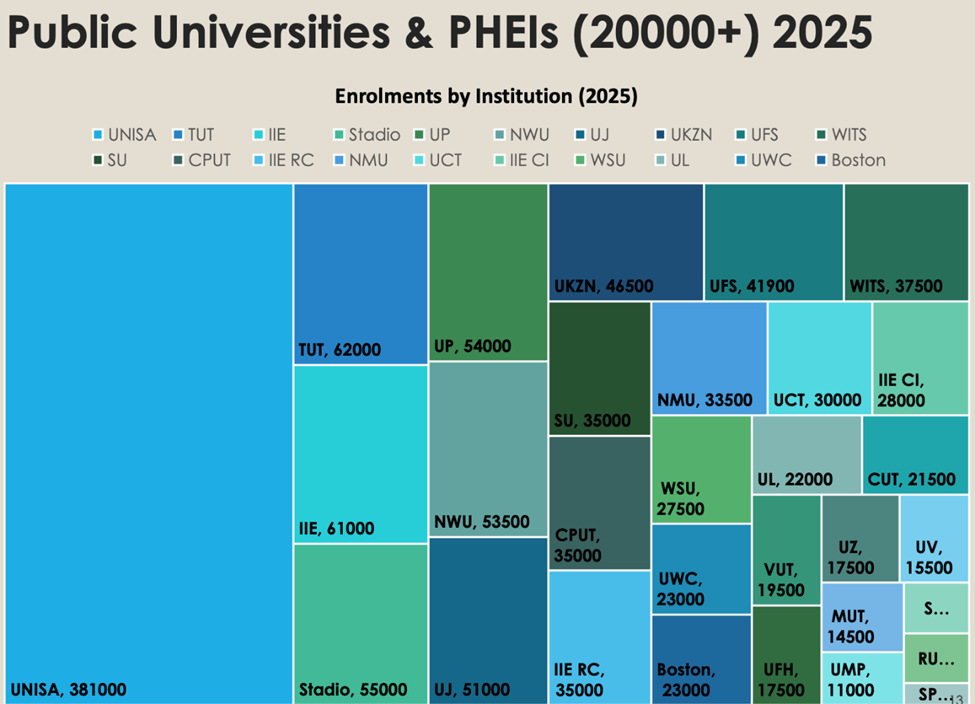
PHEIs have grown, not only in numbers, but also in diversity and sophistication. Once dominated by business colleges and teacher-training providers, the sector now spans a wide range of disciplines, from commerce and education to emerging STEM (science, technology, engineering and mathematics) and digital fields.

The Independent Institute of Education (IIE), Stadio, Boston City Campus, Eduvos and SANTS collectively account for the bulk of private enrolments. Still, a growing number of smaller, niche providers now target professional reskilling, micro-credentials, and distance learning.

The demographic profile of PHEI students also contradicts stereotypes. Nearly 70% are black African, and a significant proportion are first-generation tertiary students. Importantly, PHEIs also attract older students, including those aged 25-38, reflecting a broadening market for lifelong and flexible learning.

In essence, the DHET’s planning frameworks have underestimated the role of the private sector, both as a pressure valve and as a legitimate partner in advancing national development. The stubborn reality is that fiscal ceilings have constrained the public system’s growth: the DHET’s budget has risen nominally from ZAR137.5 billion in 2024-25 to an expected ZAR158 billion in 2027-28, a 4.8% compound annual growth rate that barely keeps pace with inflation.

Real per-student expenditure in public universities remains static, while the number of eligible applicants continues to climb. This makes the contribution of private providers indispensable, even if policy discourse on PHEIs remains confused.

Beyond filling numerical gaps, PHEIs are altering the functional logic of higher education. They are less encumbered by the bureaucratic and infrastructural inertia that constrains many public universities, allowing them to pivot more quickly to market and technological demands. Many have invested heavily in digital platforms, blended delivery, and partnerships with employers – precisely the kind of flexibility the DHET and Council on Higher Education have long urged the public system to adopt.

They also offer entry-level higher certificates and stackable degree pathways that expand participation among students who might otherwise be excluded. Their responsiveness has made them essential engines for workforce development in business, education and applied technology.

While private tuition fees are generally higher than public ones, many institutions offer bursaries, flexible payment structures, and corporate partnerships that make access feasible. Moreover, NSFAS’s chronic dysfunction has further reinforced the legitimacy of alternative, market-based models.

Whether policymakers like it or not, the binary between ‘public’ and ‘private’ higher education is increasingly obsolete. South Africa’s higher education ecosystem is a single, interdependent system characterised by both competition and complementarity. Public universities, PHEIs, TVET colleges and CET centres form a continuum that must be integrated through articulation frameworks, shared quality assurance, and equitable funding mechanisms.

The DHET’s insistence on treating private providers as peripheral risks undermines national human capital objectives. Instead, policy must shift towards coordinated expansion – recognising private institutions as legitimate partners in achieving enrolment, throughput, and employability targets.

The rise of private higher education in South Africa is not an anomaly but a structural response to the inefficiencies and constraints of the public system. Its growth embodies the adaptive logic of an evolving post-school ecosystem, where the boundaries between state and market provision blur in the pursuit of access, quality, and relevance. To continue denying its role would not only be futile, but counterproductive to the broader developmental mandate.

Expanding access

Expanding access to higher education necessitates ambitious, evidence-based reforms across multiple fronts. This includes restructuring NSFAS and forging student finance partnerships to enhance capacity, innovate delivery modes, and implement key interventions.

An overhaul of NSFAS is essential, transforming it into a decentralised, financially sustainable system. Functions should be reallocated to universities and TVET colleges for closer oversight of qualifications and fund disbursement. Portable grants or vouchers would enable students to attend any accredited institution. An income-contingent loan recovery mechanism, whereby graduates repay a portion of the funding once employed and earning above a threshold via the tax system, mirrors successful models in Australia and the United Kingdom.

This approach eliminates inefficiencies, curbs corruption, strengthens accountability, ensures financial sustainability, and shares costs between the government and graduates. Over time, this will support more students and restore some degree of trust – a prerequisite for broader access expansion.

Public-private partnerships are crucial for increasing capacity. Collaborating with the private sector can build on the trend of public-private collaboration through work-integrated learning placements, co-developed programmes, and articulation agreements. Contracting private institutions to educate students with public funding, purchasing seats, and co-investing in infrastructure are key strategies.

Government grants and guarantees can help private and community organisations establish new campuses in underserved provinces through revenue-sharing arrangements, leveraging private capacity for rapid expansion with minimal state investment while ensuring quality is monitored.

Adopting blended and flexible learning models is another vital strategy. Embracing educational technology can stretch existing capacity and increase access. A hybrid model for large first-year courses taught partly online can significantly reduce the need for brick-and-mortar expansion. Modernising distance education platforms like UNISA [the University of South Africa] to serve working adults in remote areas will improve success rates and open doors for those lacking campus access. Investment in connectivity and devices to bridge the digital divide is critical for stability.

An integrated Post-School Education and Training (PSET) ecosystem that enables movement between institution types is also necessary. Strengthening articulation and credit transfer mechanisms will absorb more students in the short term, ensuring talent isn’t wasted.

Incentivising alignment between funding and qualifications frameworks will reward institutions that receive transfers. Central application systems can redirect overflow applicants to alternative institutions, spreading the burden of expansion across different institution types and creating more opportunities within the PSET ecosystem.

Investing in infrastructure innovation is unavoidable to close the gap. Upgrading existing facilities through efficiency grants, adding teaching venues, student housing, and labs, implementing energy-efficiency retrofits, improving labs, addressing maintenance backlogs, and implementing load-shedding contingencies are critical for stability.

Innovative approaches like sharing facilities or deploying mobile “pop-up” campuses focused on high-demand fields with specialised facilities can yield significant benefits. Public works programmes building education infrastructure will create construction jobs while expanding capacity for future generations.

Unlocking access to higher education requires breaking away from incrementalism to address deeply entrenched problems, such as an overwhelmed NSFAS and vast supply-demand gaps. Structural inequities are not insurmountable; bold reforms pursuing a reimagined student funding model, cross-sector partnerships, and modernised delivery modes can make real progress towards an inclusive, high-quality system.

Costs of inaction

The payoffs are far-reaching: empowering thousands more young South Africans with skills and degrees will boost the nation’s economy through increased productivity and innovation. Educating youth from neighbouring countries will strengthen the geopolitical standing of the region as a regional hub, helping address Africa’s development challenges.

The cost of inaction is lost potential and social instability. It is time for a coalition of government, academia, industry, and civil society to drive forward the changes needed to expand access and realise this vision of sustainable growth.

In a landmark development for South Africa’s tertiary education landscape, the DHET officially gazetted the Policy for the Recognition of South African Higher Education Institutional Types (Government Gazette No 53515, 17 October 2025).

This pivotal policy reform allows private higher education institutions that meet the required academic, governance, and quality standards to be formally recognised and designated as universities or university colleges.

It marks the culmination of years of advocacy, policy refinement, and national dialogue on the equitable treatment of higher education providers in South Africa’s dynamic, evolving post-school education system. For the first time in South Africa’s democratic history, private universities can rightfully be called universities.

The promulgation of this policy signifies a victory for academic legitimacy, institutional equity, and the evolution of higher education in South Africa. It acknowledges that quality education transcends ownership boundaries and is a public good delivered by both public and private entities committed to advancing society. The door has finally opened to a future where collaboration, innovation, and excellence define the university experience across all sectors.

Dr Linda Meyer is managing director of IIE Rosebank College. This is a summation of her keynote address given at a Council on Higher Education Colloquium held on 18 September 2025. The subsequent developments have been added as a solution-oriented move for the good of the higher education institutions and economic growth.

This article is a commentary. Commentary articles are the opinion of the author and do not necessarily reflect the views of University World News.


Advtech Updates

By Tamara Thomas June 12, 2026
Advtech Limited (Incorporated in the Republic of South Africa) (Registration number 1990/001119/06) Share code: ADH ISIN: ZAE000031035 (“Advtech” or “the Company”) DEALINGS IN SECURITIES BY A PRESCRIBED OFFICER OF THE COMPANY In compliance with paragraphs 6.77 to 6.91 of the JSE Limited Listings Requirements the following information is disclosed in respect of dealings in Advtech securities by a prescribed officer of the Company. 
By Tamara Thomas June 9, 2026
Deputy Minister for Higher Education and Training, Dr Mimmy Gondwe, kicked off sector-wide engagements by meeting Advtech’s senior leadership at Emeris’ Sandton campus on Monday, 8 June 2026. This follows her recent address at Advtech’s Rosebank International brand launch. The aim of these engagements is to recognise and collaborate with private institutions that positively contribute to the Post-School Education and Training sector. Advtech’s senior leadership discussed opportunities for public-private partnerships, including leveraging the agility of the private sector to widen access for students to quality education. During the visit, Dr Gondwe spent time with Emeris students and toured the campus’ world-class facilities, including its state-of-the-art sports centre. Said Dr Gondwe prior to the visit, “The conversation can no longer be about whether private higher education institutions have a role to play; that question has long been settled; the focus now is on collaborating more effectively and responsibly to ensure that higher education supports national development and inclusive economic growth.” “Advtech welcomes our positive recent engagements with Dr Gondwe. We look forward to collaborating with her department going forward and appreciate her commitment to finalising the process that will enable Emeris and Rosebank International to finally achieve university status,” said Geoff Whyte, Group CEO of Advtech.
By Tamara Thomas June 3, 2026
Play should sit naturally in early childhood education, as it reflects how young children come to know themselves, others and the world. Yet too often, play is the very space that requires the most protection. This tension usually arises from a culture that prioritises early academic achievement and holds the belief that accelerating formal learning guarantees future success. When children are rushed or pressured into formalised academic outcomes too early, short-term gains may be visible for some, but the long-term cost can be significant, an education expert says. “Play is not separate from learning, it is the medium through which learning becomes possible,” says Lynda Eagle, Advtech Schools Specialist: Early Years Phase. “Early learning that prioritises performance over understanding risks weakening curiosity, motivation and wellbeing. Strong foundations are built not through acceleration, but through experiences that nurture thinking, communication, collaboration, and joy - conditions that sustain lifelong learning.” Eagle explains that children engage with play in ways that reflect their own pace, interests and needs. “It provides space for difference and diversity while offering opportunities for connection and shared experience. Importantly, play supports emotional regulation and prepares children for future learning by strengthening the foundations required for inquiry, reflection and participation in real-world contexts.” Play and responsiveness are often described as abstract concepts, yet they require intentional commitment from both educators and families, says Eagle. “Responsiveness asks adults to understand the value of play and to reflect on their role within it: how they observe, when they intervene, how they extend thinking and how they remain present without directing or interfering. By engaging in careful observation and thoughtful support, adults come to know children more deeply, including learning about their interests, strengths and emerging identities. “It also plays a big role in building key life skills - things like thinking deeply or critically, solving problems, working with others, communicating effectively and self-management. When children play, they’re constantly exploring new ideas, testing their theories, inventing solutions and figuring out how the world works. Along the way, they learn to take manageable risks and handle challenges. And, very importantly, to stick with things even when they’re difficult, which gradually builds their confidence and a real mindset for growth.” PLAY AND RESPONSIVENESS – IMPORTANCE OF PARTNERSHIPS Partnerships between families and educators are central to this work, Eagle says. “Together, they can create learning experiences that balance freedom and structure, offering both flexibility and clear boundaries. This balance provides children with emotional safety while teaching respect for themselves, for others and for the environment. Such stability supports the development of empathy, resilience and perseverance.”  Within these conditions, children form relationships, make connections, and gradually become independent learners. They develop conceptual understanding and learn to reason, transfer knowledge, and apply ideas in new contexts, moving from concrete experience toward more abstract thinking. “Any tension between our aspirations for children and our understanding of play and responsiveness deserves careful reflection,” Eagle warns. “When adults deepen their understanding of why play matters and how responsiveness supports learning, they are better positioned to guide children with intention and trust. Ultimately, early learning is not only about what children know, but about how they think, how they relate to others, and how they come to see themselves in the world, a world full of possibility.”
By Tamara Thomas May 28, 2026
Advtech Limited (Incorporated in the Republic of South Africa) (Registration number 1990/001119/06) Share code: ADH ISIN: ZAE000031035 (“Advtech” or “the Company”) DEALINGS IN SECURITIES BY PRESCRIBED OFFICERS, DIRECTOR OF A MAJOR SUBSIDIARY AND THE COMPANY SECRETARY OF THE COMPANY In compliance with paragraphs 6.77 to 6.91 of the JSE Limited Listings Requirements the following information is disclosed in respect of dealings in Advtech securities by prescribed officers, director of a major subsidiary and company secretary of the Company.
By Tamara Thomas May 27, 2026
ADvTECH Limited (Incorporated in the Republic of South Africa) (Registration number 1990/001119/06) Share code: ADH ISIN: ZAE000031035 (“ADvTECH” or “the Company”) RESULTS OF THE ANNUAL GENERAL MEETING In terms of section 6.63 of the JSE Listings Requirements, shareholders are hereby advised that at the annual general meeting (“AGM”) of shareholders of the Company held today, Wednesday 27 May 2026 all the proposed ordinary and special resolutions, as set out in the notice of annual general meeting contained in the Integrated Annual Report, were approved by the requisite majority of shareholders present or represented by proxy. Details of the results of voting at the annual general meeting are as follows:
By Tamara Thomas May 27, 2026
Dr Wendy Mahoney has made history as the first PhD graduate of The Vega School at Emeris and as the first recipient of the school’s Black Pencil Award for Excellence. She was recently conferred the qualification IIE Doctor of Philosophy in Brand Leadership at The Vega School at Emeris Umhlanga’s Class of 2025 graduation ceremony. Reflecting on receiving her PhD after a three year part-time journey, Dr Mahoney described the moment as deeply emotional and meaningful. “This is the most incredible feeling. I am deeply honoured, blessed and grateful to every single person who cheered me on,” she said. “It was such a profound moment for me because The Vega School at Emeris has been such an intricate part of my personal journey. What made the occasion even more meaningful was the immense pride I felt in the room for this achievement. It was not just my achievement - it was our achievement”. Dr Carla Enslin (Dean of the Postgraduate & Research Centre at Emeris) said the launch of the IIE Doctor of Philosophy in Brand Leadership in 2021 was a significant moment for The Independent Institute of Education (IIE) and for The Vega School at Emeris. “It’s a first of its kind qualification and breaks new ground both locally and internationally,” she said. “The PhD purposefully produces original frameworks, original models, creative insights to innovative and meaningful brand building. We expect our PhD graduates to be the individuals advancing the values-based leadership that grows an organisational culture and the practises that transform communities, businesses, environments,” continued Dr Enslin.
By Tamara Thomas May 27, 2026
Advtech Limited (Incorporated in the Republic of South Africa) (Registration number 1990/001119/06) Share code: ADH ISIN: ZAE000031035 (“Advtech”) DEALINGS IN SECURITIES BY PRESCRIBED OFFICERS, A DIRECTOR OF A MAJOR SUBSIDIARY, AND COMPANY SECRETARY: SHARE VESTING In compliance with paragraphs 6.77 to 6.91 of the JSE Limited Listings Requirements, the following transactions relating to prescribed officers, director of a major subsidiary and company secretary dealings are hereby disclosed, in terms of the provisions of the Advtech Management Share Incentive Scheme (MSI), regarding performance and retention shares that have vested after 3 years.
By Tamara Thomas May 25, 2026
Access to higher education remains one of South Africa’s most powerful tools for social mobility, economic growth, and national development. For many young people - especially first-generation students - it represents the chance to break cycles of poverty and build better futures for themselves and their families. While it is estimated that between 30-40% of qualifying students can’t access higher education for various reasons annually, simply opening the doors of higher learning to more young people is not enough, an education expert says. Peter Kriel, Executive: Operations at Advtech and The IIE ’s Academic Centre of Excellence, says access and quality must go hand in hand: “True access means creating opportunities for students to enter higher education, thrive within it, graduate with the skills and confidence needed to build meaningful careers.” He says there are five practical ways for South African higher education institutions to expand access while supporting student success: 1) Develop multiple entry pathways Traditional admission routes exclude many talented students whose school backgrounds may not fully reflect their potential. Institutions can widen participation by offering foundation programmes including higher certificates, extended curriculum streams, bridging courses and alternative admission pathways. These flexible entry points acknowledge that academic readiness is not equally available across all communities. By providing targeted academic preparation, institutions can identify and nurture talent that might otherwise be left behind, without lowering standards. “Widening participation is not about lowering academic standards, but rather about creating appropriate pathways that enable students to reach those standards,” says Kriel. 2) Strengthen transition support programmes The jump from school to higher education is often daunting. Students face new academic demands, greater independence, and the need for advanced analytical skills. Strong orientation programmes, first-year experience initiatives and structured academic skills workshops help ease this transition. Proactive support in the critical first year significantly improves retention and builds the foundation for long-term success, notes Kriel. 3) Invest in academic development initiatives Ongoing support is essential. Tutoring services, writing centres, peer-assisted learning programmes, dedicated academic development resources help students bridge knowledge gaps and build confidence. These initiatives are particularly valuable for students navigating higher education for the first time in their families, turning potential struggles into opportunities for growth. 4) Use data to identify at-risk students early Institutions should harness student success analytics to spot challenges before they become crises. Early warning systems allow for timely interventions - whether through additional tutoring, counselling, or personalised support. “Proactive data-driven approaches dramatically improve completion rates and ensure that expanded access translates into actual graduate outcomes,” says Kriel. 5) Create inclusive and adaptive learning environments Students succeed best when they feel they belong. Inclusive campuses that respect diversity, foster connection, and value different backgrounds help students engage fully with their studies. AI and adaptive technologies further enhance this by enabling personalised learning pathways - adjusting content, pace, support in real time to match each student’s unique needs, learning style and progress. Feeling respected and supported by lecturers and peers, ensures increased persistence and chances for success. BROADER IMPACT AND SHARED RESPONSIBILITY When students complete their qualifications, the benefits multiply, says Kriel. “Graduates access better employment, develop critical thinking and professional skills, and often become role models who inspire the next generation. This creates a powerful ripple effect: stronger families, more skilled communities and broader economic growth.” Students also have a key role to play.  Actively using available support services, building good study habits, managing time effectively, engaging with lecturers, staying curious can make a significant difference, he advises. At the same time, institutions must recognise that many students enter higher education while dealing with financial pressure, family responsibilities, or personal challenges. Support systems therefore need to be visible, accessible and proactive - reaching students before they have to ask for help. “Expanding access to quality higher education is one of South Africa’s greatest opportunities for meaningful change. This means not simply increasing enrolment numbers, but an active strategy to unlock human potential, enabling individuals to contribute meaningfully to their communities and the broader economy.”
By Tamara Thomas May 15, 2026
New name and visual identity prepare the way for university status and further rapid growth
By Tamara Thomas May 6, 2026
The body content of your post goes here. To edit this text, click on it and delete this default text and start typing your own or paste your own from a different source. One of the most important expectations placed on higher education today is that it prepares students for successful careers. While intellectual development remains central to the mission of universities, students increasingly seek - rightly so - educational experiences that provide clear pathways into professional life. Career-focused education, therefore, plays a vital role in connecting academic learning with the practical realities of the workplace. Peter Kriel, Executive: Operations at The Independent Institute of Education , says for this reason, it is incumbent on universities to actively strengthen the link between learning and employability. “Students enter higher education with the hope that their qualifications will enable them to build meaningful careers,” he explains. “Institutions therefore have a responsibility to ensure that academic programmes provide both theoretical depth and opportunities for practical application.” Career-focused education does not diminish the intellectual value of higher education. Rather, it enhances it by ensuring that academic knowledge can be applied to real-world contexts. “In today’s economy, employers seek graduates who can demonstrate both subject knowledge and practical capabilities. Skills such as teamwork, communication, critical thinking, and problem-solving are highly valued across industries. “Universities must help students develop these competencies by integrating practical life skills opportunities into academic programmes. Work-integrated learning, internships, project-based learning, and industry collaborations also provide students with valuable opportunities to apply what they have learned in real-world settings.” These experiences help students build confidence while also developing the professional skills that employers seek, says Kriel. Institutions seeking to strengthen career-focused education can consider the following approaches. 5 WAYS UNIVERSITIES CAN STRENGTHEN THE FOCUS ON CAREER-READINESS  1. Expand work-integrated learning opportunities Internships, practical placements, and industry projects allow students to gain direct exposure to professional environments. This means that students graduate with practical experience that enhances employability. 2. Strengthen career guidance and development services Career counselling, CV workshops, and interview preparation help students transition successfully into the workplace. Students, therefore, gain clarity about career pathways and develop stronger job-search skills. 3. Develop strong employer partnerships Collaboration with industry partners can provide insights into emerging skills requirements and new employment opportunities. Institutions must strengthen their alignment with labour market needs. 4. Embed professional skills - including AI skills - within curricula Communication, teamwork, leadership, and problem-solving skills should be integrated into academic programmes rather than treated as separate activities. This would allow graduates to become well-rounded professionals capable of contributing effectively in the workplace. In addition, universities should explicitly teach students how to responsibly and effectively use AI tools, given the rapidly changing nature of the workplace. This includes developing critical AI literacy skills such as prompt engineering, ethical AI use, evaluating AI-generated outputs, and integrating AI to augment human capabilities rather than replace them. 5. Encourage entrepreneurship and innovation Not all graduates will follow traditional employment pathways. Institutions that promote entrepreneurial thinking help students identify opportunities to create their own ventures. It is also a fact that entrepreneurship contributes to job creation and economic development. Given all this, it is clear that career-focused education delivers benefits that extend beyond individual graduates. For students , it increases confidence and preparedness as they transition from study to employment. Exposure to professional environments helps students better understand industry expectations and workplace dynamics. For institutions , strong employability outcomes enhance reputation and strengthen relationships with industry partners. For society , career-focused education contributes to economic growth by ensuring that graduates possess the skills required to support innovation and productivity. “Higher education institutions have a unique opportunity to shape the future workforce by designing programmes that combine academic excellence with practical relevance. Institutions that embrace career-focused education ultimately strengthen their contribution to society,” says Kriel. “When higher education institutions actively connect learning with professional opportunity, they empower graduates to build careers that are both personally fulfilling and economically productive. As economies evolve and industries continue to transform, the ability of higher education to bridge the gap between learning and the workplace is essential.”